

Structured Cabling & Network Wiring
Every camera, phone, door reader and access point in your building is only as good as the wire behind it.
When footage freezes, calls drop, or a card reader goes dead for no reason anyone can explain, the cause is usually not the device on the wall — it's the cabling nobody ever labeled, tested or ran to spec.
We are a
structured cabling contractor in Queens, NY that treats the low-voltage backbone as the actual job, not an afterthought. Communications has been our trade since 1983, and George inspects every install before it's called done.
What structured cabling actually is
(and why "some Cat6 in the ceiling" isn't it)
Structured cabling is the planned, labeled, tested network of low-voltage wiring that ties a building together — the drops at each desk, the runs to every camera and access point, the patch panels, the rack, and the backbone between floors. "Structured" is the operative word. A pile of blue cable stuffed above a drop ceiling and crimped by feel will pass a quick ping test on day one and then quietly cost you for years: intermittent drops, PoE devices that brown out at the end of a run, and a comms closet no future tech can make sense of.
The mechanism behind most cabling failures is boring and physical. Twisted-pair copper rejects interference because the pairs are twisted at a precise rate; untwist too much at the termination, kink the cable around a tight corner, or run it alongside 120V power and fluorescent ballasts, and you get crosstalk and signal loss the network has to work around. Push a run past 100 meters — easy to do across a Queens warehouse or a multi-floor office — and the signal degrades no matter how good the jack is. Do it right and the same copper is invisible for a decade.
How We Run a Cabling Job, Step by Step
Every job starts with a walk. We look at where the devices need to live, where the internet and rack come in, how far the longest run is, and what the building will let us do — because a 1920s Jamaica storefront with plaster walls and a tin ceiling is a different animal than an open LIC loft.
1. Pathways First
We map conduit, J-hooks, cable tray and riser routes before pulling anything, keeping data physically separated from power to avoid interference.
2. Home-run the Drops
Each outlet runs back to a central patch panel — no daisy-chaining, no mystery splices in the ceiling. That's what makes a system serviceable later.
3. Terminate to Standard
We keep the twist tight to the jack, use one wiring standard (T568B) throughout, and dress the rack so the next person can read it.
4. Label Both Ends
Every drop, port and patch gets a number that matches a printed map. This is the single thing most cheap jobs skip and the single thing that saves you money on every future service call.
5. Test and Certify
We test each run and can provide certification results — wire map, length, insertion loss and crosstalk — so you have proof the plant meets spec, not just a promise.
Cat5e vs. Cat6 vs. Cat6A
what actually matters for your building
This is where a lot of money gets spent for the wrong reasons. Cat5e handles gigabit fine and is still perfectly good for most phones, standard workstations and many cameras — if your runs are short and clean. Cat6 has tighter tolerances and better crosstalk performance, handles 10-gigabit over shorter distances, and is the sensible default for most new commercial offices and PoE camera runs.
Cat6A is the heavy copper: full 10-gigabit to 100 meters and better heat handling for dense PoE, which matters in server rooms, high-camera-count sites and anything you want to leave alone for fifteen years.
Our honest take: for a typical office, Cat6 is the right buy — Cat6A everywhere is often money that would do more good elsewhere in the system. But we'll run Cat6A to the closet, the camera backbone, or the wireless access points where the extra headroom actually earns its keep. We'd rather put the upgrade where it counts than sell you a whole building of cable you won't use.
Cleaning Up a Messy Existing Cable Plant
A lot of our cabling work isn't new construction — it's rescue. You inherit a comms closet that looks like a bird's nest, nothing's labeled, half the ports are dead, and every service call turns into an archaeology dig.
We can come in, trace and document what you have, re-terminate what's salvageable, replace what's damaged, and dress and label the rack so it's finally serviceable. Sometimes that's cheaper than a full re-pull; sometimes the old plant is far enough gone that re-cabling is the honest answer. We'll tell you which, and why, before you spend.
This ties directly into everything else we do. Clean cabling is what makes
video surveillance deliver clear footage, what keeps a
VoIP phone system from dropping calls, and what lets
access control stay reliable. It's the foundation the rest of the building rides on.
Fiber, Backbone and the Multi-floor Reality
Copper tops out at 100 meters. In a multi-floor Bronx building or a big warehouse, that means the run between floors or between buildings needs
fiber as the backbone, with copper distributing from a closet on each floor. Fiber also earns its place where you've got long distances, heavy bandwidth, or electrical noise you want to sidestep entirely. We handle the riser runs, the closet-to-closet backbone, and the hand-off to your copper, so the whole plant is one coherent system instead of a patchwork.
Affordable Structured Cabling Solutions
Understanding Cabling Costs in NYC
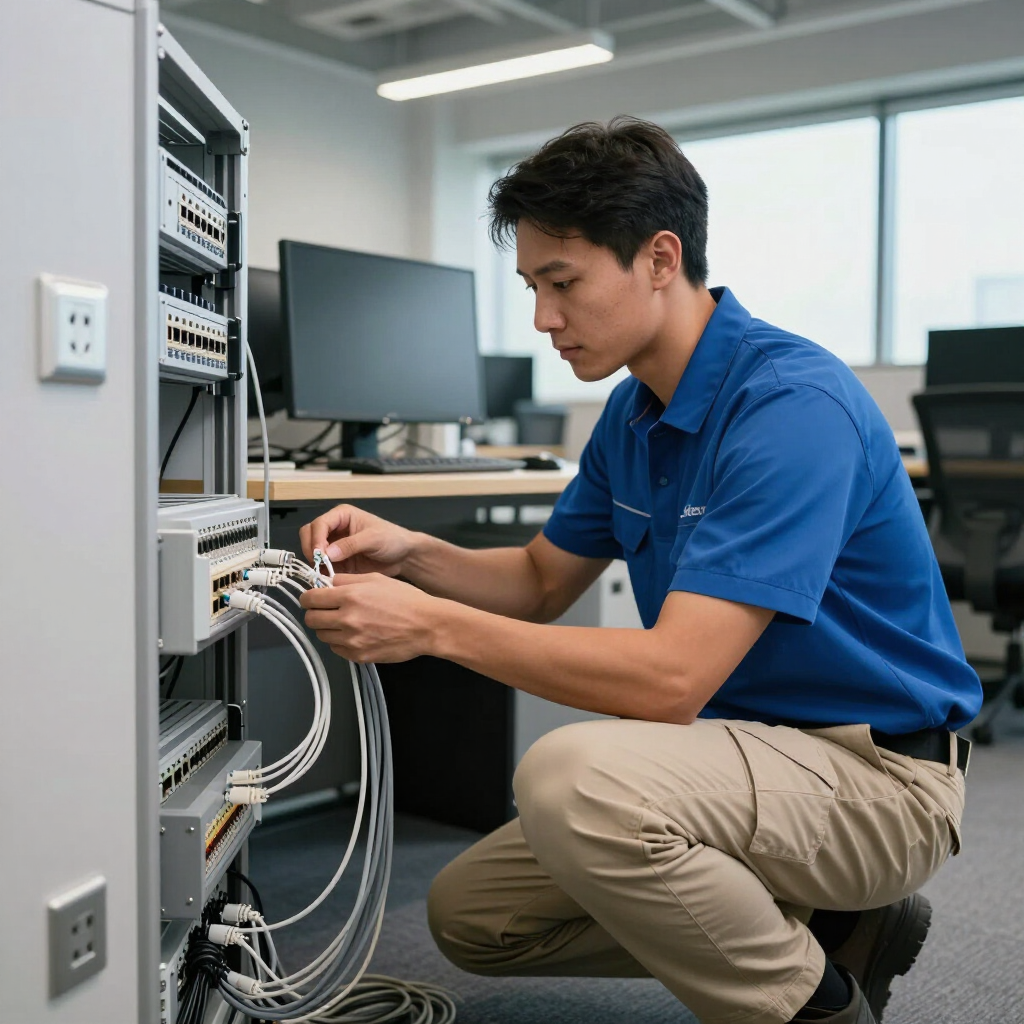
What Influences Cabling Prices?

Factors Affecting Your Quote
Common Questions About Access Control
What's the difference between Cat5e, Cat6 and Cat6A?
All three are twisted-pair copper; the difference is how much bandwidth they carry and how far. Cat5e handles gigabit and is fine for most phones and standard workstations on short runs. Cat6 has tighter crosstalk tolerances, handles 10-gigabit over shorter distances, and is our default for new commercial offices and PoE cameras. Cat6A carries full 10-gigabit to 100 meters and handles dense PoE heat, which matters in server rooms and high-camera-count buildings. Tell us what the building has to do and we'll spec the right category room by room — call 718-577-8339.
Can you cable a whole office or building, not just one room?
Yes — whole-building cabling is the core of what we do. We handle the full plant: drops at every workstation and device, the runs to cameras and access points, patch panels and rack build-out, and the fiber backbone between floors when runs exceed copper's 100-meter limit. We can phase it around an occupied office so your operation keeps running. Send us a floor count and rough drop count and we'll scope it.<a value="contact" label="" type="page" href="/contact" data-runtime-url="/contact"> Request a cabling estimate.
Do you test and certify the cabling?
We do. Every run gets tested, and we can provide certification results — wire map, length, insertion loss and crosstalk — so you have documented proof the plant meets spec instead of a verbal "it works." Certification matters most on new installs you're warranting, high-bandwidth backbones, and anything you'll hand to another vendor. Ask for certified results when you request your quote at 718-577-8339.
Can you clean up and re-terminate a messy existing cable plant?
Often, yes. We trace and document what you have, re-terminate what's salvageable, replace what's damaged, and dress and label the rack so it's serviceable going forward. Sometimes cleanup and re-termination is far cheaper than a full re-pull; sometimes the plant is too far gone and re-cabling is the honest call. We'll tell you which after we see the closet — book a walkthrough at 718-577-8339.
How much does office network cabling cost per drop?
In the NYC area a straightforward commercial drop commonly runs about $150–$300 each when there's a full day's worth, and more for long runs, hard pathways, plenum-rated cable, Cat6A, or after-hours work in an occupied space. Small jobs carry a minimum because the rack, patch panel and testing setup cost the same for five drops or fifty. We give you the per-drop number and what moves it before any work starts — call 718-577-8339 for a real number.
Get Your Building Wired Right the First Time
Tell us how many drops, how many floors, and what has to run over the cable — cameras, phones, access control, or all three — and we'll walk the building before quoting a foot. Owner-inspected, tested and labeled, done by a Queens shop that's been in the communications trade since 1983.
NYS Licensed Alarm Installer #12000086085 · In business since 1996